Dino Duel devlog2 min read
Dino Duel 0.5.1: daily check-ins, Rare clutches, and sets
A reason to come back every day, better odds for patient collectors, and tabs that open about ten times faster.
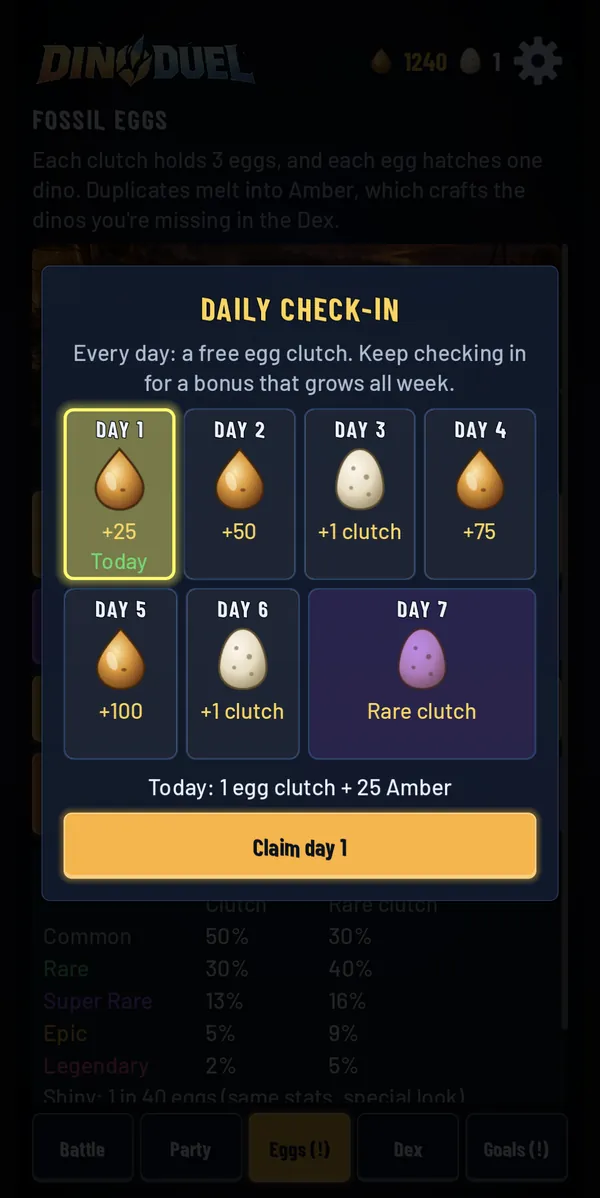
0.5.1 adds a daily check-in: a free egg clutch every day, plus a bonus that builds up to a Rare clutch on day 7. It pops up once a day, including when the game comes back from the background. Rare clutches can also be bought for 500 Amber, with much better odds, and sets reward collecting dino families and themes with Amber and badges.
Battles got punchier, with hit effects and a new results screen, and UR and Shiny cards now shine as you tilt your phone. Text is bigger across the tabs and popups. And your progress is now part of your phone's Google backup, so it can come with you to a new phone.
Why the Dex took a second to open
Every creature in Dino Duel has a 1000×1500 painting. That's the right size for the full-screen card view, but the Dex shows dozens of cards at once, each only a few hundred pixels wide. Opening it took 1.1–1.3 seconds on my phone, because every card was decoding a full painting it would immediately shrink.
My art pipeline script already resized new paintings into place, so I extended it to also write a 360 px thumbnail for each creature. Any card up to 270 game units wide (the screen is 720 wide) now uses the thumbnail, and only the full-screen view loads the original.
Thumbnails stay in memory once they're loaded. 45 of them take about 45 MB, compared with roughly 270 MB for the full paintings the Dex used to hold. At startup the game also requests every thumbnail on background threads, so the first tab you open is already warm.
With that change, the Dex opens in about 0.1 seconds.
One gotcha: small textures drawn at a fraction of their size look grainy without mipmaps, so new thumbnails need mipmaps/generate=true in their import settings, followed by a re-import.